
One powerful page
Constraints focus efforts.
Writing clarifies thinking.
One page does both.
A decent one-pager converts abstract intentions into shared understanding. Used well, a strong brief can help a team explore new territory, create shared commitments, and deliver on strategy.
Welcome. Product, Briefly is a collection of one-page briefs about building products and the people who create them, drawn from two decades of work in new ventures spanning a breadth of industries. Each one can be read in five minutes and discussed for an hour. They cover cover different facets of Product work while also serving as examples of the form.
It’s built to be taken apart: use what fits straight away, draw inspiration from the collection, make the rest your own. Take a brief, or make a brief.
| productbriefly.com | Briefs | Perks | About | Work with Me |
Brevity, origins, and applications
Churchill sent a memo to his War Cabinet in 1940, entitled Brevity. Reports were to be written in “short, crisp paragraphs” and no longer than a single page. He was tired of jargon, and wasted time “spent looking for the essential points.”
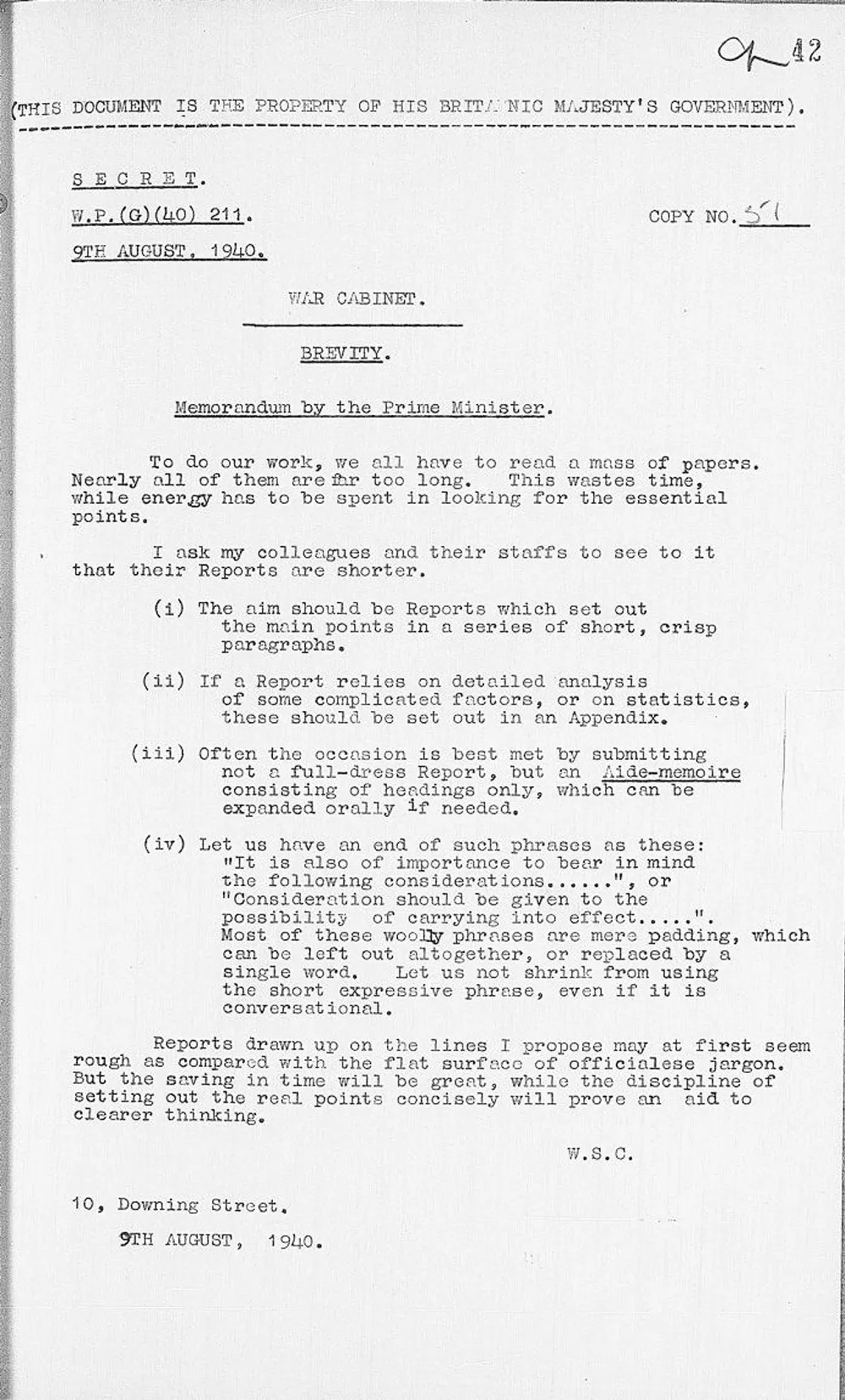
… the discipline of setting out the real points concisely will prove an aid to clearer thinking.
W.S.C
It worked so well it became a staple of the Western military.
However, that’s not actually where my journey started.
Advertising arrived in a golden age during the 1960s. Marketing, media, and manufacturing converged into a creative revolution where now an industry catering to the Consumer learned to sell emotions, brands, and ideals. Creative Briefs were born to bridge the client’s business goals to the eccentric art department without anything getting lost in translation.
In the early 2010s, I was building technology for clients in the advertising industry, and that’s where I learned the brief. Later, while leading a Product team at a consumer electronics company, a brief became a necessary prerequisite to any meaningful work; some were like Churchill’s, others more like Madison Avenue’s. Product briefs, strategy briefs, phase briefs, design briefs… the list goes on.
One page, broad applications. Constraints, clarity, communication.
Sharpening the stylus
It was later that I refined the practice of quickly drafting a brief, using it to gather input, refine it, and set direction. While leading a team building a little consumer device for a Silicon Valley cloud storage startup, briefs became a foundation for creating shared language for direction, scope, and success. This practice persists with me now, across the teams I’ve built and led, people I’ve helped grow, and programs I’ve run. It’s simple, fast, and effective.
Our teams use briefs to chase out ambiguity, communicate vision, and get everyone pointed in the same direction. Briefs are clear sketches for bold concepts.
Communication not documentation
Please take just one key point away from this:
Briefs are an artifact of thinking and discussion.
Documents don’t matter. Thinking - alone, together, and distributed - is what gets the work done. Writing a brief and cutting it down to a page forces a person to think through what they’re getting at. Taking that page and letting others read it and then discussing it rounds out the thinking of the group and surfaces the hidden factors and drives agreement. Integrating the thinking of the group, then cutting it back down to a single page, reshapes the thinking to be collective and compresses it and forces prioritization. Revising it so anyone attached to the work can quickly understand it and their relationship to it means clear thinking propagates. Work accelerates.
Louder, for the people in the back
One page is a useful constraint that forces clarity of thinking and prioritization.
Briefs are an artifact of thinking and discussion.
Drafting, discussing, integrating, revising, and distributing is what makes an effective brief.
Don’t be too clever.
The methods you’ll find in Product, Briefly are all built upon this concept. Below you’ll find the brief I share with teams new to the concept.
To make it easy to jump start your own team, you can download a .pdf version and discuss it with your people, and take the whole concept for an easy test-drive.

Briefs, Briefly
“Give me the freedom of a tight brief.”
~David Ogilvy
Briefs are for establishing shared context for work done together, or getting clarity for work done alone.
A brief says “this has been given thought and is worthy of consideration.”
Creating a brief chases out ambiguity and forces collaboration. It's not a magic document, but rather the significance lies in what happens in order to arrive at that artifact. We set a common target before starting and accountability for getting it done. A good brief contains at least what we're after and how we know we've achieved it, who's important to include, and when it's due.
There are many different types of briefs:
Exploratory: how we'll think about the right questions to ask, and how we'll know when we've reached the right questions to answer.
Strategy: our plan, where we'll play (and won't), and what winning looks like.
Assignment: what we intend to do and why it’s significant.
Product: outlining some value you hope to create in the world, that the world will compensate you for.
Creative: any guardrails and inspiration for new types of exploration.
No template, no secrets, no style points. Simply put in the work to be concisely on the same single page, and be accountable for what you said you were going to do. Briefs are to keep the reference point visible.
Some thoughts on the creative brief from the ad-agency world:
What is the creative brief? It is a blueprint, a guide, even a source of inspiration. It details our objectives, audience/community, message or utility, the context in which we’ll engage, timing and budget. In short, the what, who, where, when.
The brief is the what we are doing. The creative is the how.
Where can you put briefs to work today?

Originally published on productbriefly.com
Start today
Lead by example - pick one pressing topic together, and volunteer to draft the first one-pager.
You can jump-start thing with Briefs, Briefly and use it to activate your discussion; it’s a one-page .pdf so you can load it into Slack and chat asynchronously, attach it to a calendar item and talk over video, or print it to pass around the boardroom.
